


Anti-money laundering (AML) software demos are a sight to behold.
With every alert neatly explained and every ownership chart loading instantly, these demos turn a suspicious transaction into a tidy case in a few clicks.
But the reality could not be further from that.
When AML software platforms meet your registry coverage, legacy core banking details, and local reporting rules, things may start falling apart. When your compliance team has no spare time to incorporate another system, your plan to streamline AML compliance can unravel at the seams, and even a product brochure may not cut it.
The best AML software will help your compliance team handle data even when it’s messy. And the best choice depends on the risk you’re trying to control.
For instance, a bank processing millions of payments does not need the same platform as a lender verifying small businesses across 40 countries. Buy on the strength of a feature list alone and your compliance team may end up paying for three tools that refuse to share context.
To help you in your hunt for the right AML software, we’ve compiled a list of eight platforms based on their unique capabilities, the use cases they cater to, and their publicly available reviews on third-party sites like G2, Gartner, Trustpilot, and more.
Which AML software is best for each use case?
The right AML software depends on your unique business needs. Know Your Customer leads this list for corporate onboarding and cross-border KYB. Feedzai and Nasdaq Verafin make more sense for transaction-heavy financial institutions. LSEG World-Check is mainly a risk-intelligence layer, while Quantexa is built for relationship-led analysis. The right answer depends on the gap you need to close.
What does AML software cover?
AML software helps an organization identify customers, screen people and businesses, monitor activity, investigate alerts, and keep evidence for reporting. The United Nations Office on Drugs and Crime describes three stages of money laundering such as placement, layering, and integration, while noting that real cases may combine or repeat them.
| AML function | What the software checks | What to ask in a demo |
|---|---|---|
| Customer due diligence | Identity, business registration, ownership, control, risk factors | Can analysts see the source and date of each piece of evidence? |
| Screening | Sanctions, PEPs, close associates, adverse media, enforcement data | Which lists and jurisdictions are covered, and how often do they update? |
| Transaction monitoring | Payments and account behavior over time | Can your team test rules against historical data before going live? |
| Investigations | Alerts, related entities, analyst actions, decisions, escalations | Can a reviewer reconstruct the case without opening five other systems? |
| Regulatory reporting | SARs, STRs, CTRs, management reporting, audit evidence | Which filing formats and jurisdictions are supported natively? |
8 Best AML software providers at a glance
A corporate lender, a remittance provider, and a retail bank may need different AML software even when they use the same regulatory vocabulary. When choosing an AML solution for your needs, identify where risk exposure is highest and opt for one that focuses its efforts there.
| Vendor | KYC Identity Verification | KYB And Beneficial Ownership | Sanctions, PEP, Adverse Media Screening | Transaction Monitoring | AI/ML or Behavioral Risk Scoring | Case Mgmt And Investigations | Regulatory Reporting | Entity Resolution And Network Analysis | Deployment Model |
|---|---|---|---|---|---|---|---|---|---|
| Know Your Customer | Yes | Yes | Partial | Yes | Yes | Yes | Yes | Yes | Cloud |
| SEON | Yes | Partial | Yes | Yes | Yes | Partial | Yes | Yes | Cloud |
| LexisNexis Bridger Insight XG | Partial | Yes | Yes | Partial | Yes | Yes | Partial | Yes | Cloud and on-premises |
| NICE Actimize | Partial | Partial | Partial | Partial | Yes | Partial | Partial | Yes | Cloud |
| LSEG World-Check | Partial | Partial | Yes | Partial | Partial | Yes | Partial | Yes | Cloud |
| Quantexa | Partial | Partial | Partial | Partial | Yes | Partial | Partial | Yes | Cloud, on-premises, or Hybrid |
| Feedzai | Partial | Partial | Yes | Yes | Yes | Yes | Yes | Yes | Cloud |
| Nasdaq Verafin | Partial | Yes | Yes | Yes | Yes | Yes | Yes | Yes | Cloud |
How to evaluate AML software providers?
FATF‘s recommendations are the international standards that countries use when building anti-money laundering and counter-terrorist financing regimes. FATF divides them into seven areas which can be used while selecting the right AML solution for your needs:
- AML/CFT policies and coordination: The platform should fit the governance and risk ownership around your program
- Money laundering and confiscation: Controls should help identify suspicious flows and preserve investigation evidence
- Terrorist financing and proliferation financing: Screening and monitoring should reflect the risks in your products and markets
- Preventive measures: Customer due diligence, screening, monitoring, and record-keeping need clear workflows
- Transparency and beneficial ownership: AML tools should show who owns or controls a legal entity
- Competent authorities and institutional measures: Reports, audit trails, permissions, and examination evidence must be usable
- International cooperation: Cross-border data, language, registry, and reporting requirements need early testing
Which are the 8 best AML software providers in 2026?
Here are eight of the best AML software solutions, and for each, we’ve captured how they position themselves, what they’re built to do, and what public reviews say about the product.
1. Know Your Customer
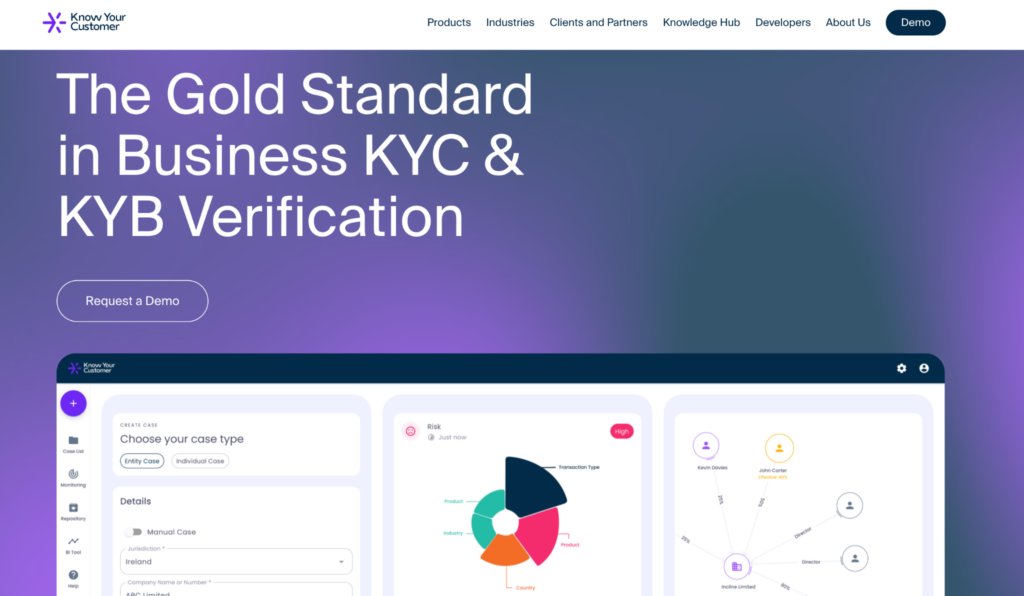
Know Your Customer is the strongest fit in this list when the AML problem begins with a business customer. The system covers business KYC and KYB along with registry data, UBO identification, corporate onboarding, and periodic review across more than 140 countries. It also provides bespoke solutions with organizational charts, document storage, OCR, real-time monitoring, reporting, configurable workflows, and integrations.
G2 users praise ease of use, digital onboarding, and the depth of the business view. One reviewer reported onboarding time falling by more than three quarters. Other reviewers mention a learning curve and strict identification checks.
| Pros from third-party reviews | Cons from third-party reviews |
|---|---|
| Easy digital onboarding and a broad view of business and customer data | Some users find the system less intuitive at first |
| Strong registry and ownership information for KYB work | Limited review volume |
Best for: Banks, lenders, payment providers, and corporate-service firms that need official business data, ownership analysis, and ongoing KYB review.
Test before buying: Registry coverage in every country you serve, document provenance, refresh timing, and how the product hands off cases to transaction monitoring.
2. SEON
SEON sits at the intersection of fraud prevention and AML. Its AML product covers screening, transaction monitoring, fraud signals, customer risk, and investigations, while its first-party signals include device, network, digital-footprint, and behavioral data.
Users repeatedly mention the clear interface, responsive support, real-time risk signals, and flexible rules. The less flattering feedback is specific too. Users mention slow loading with large data sets, limited velocity logic in rule backtesting, cluttered custom fields, and a learning curve during setup.
| Pros | Cons |
|---|---|
| Simple interface to investigate accounts and connections | Large data sets may load slowly for some users |
| Flexible rules, screening of sanctions, and responsive support | Backtesting rules and layout customization are not enough to cover all requested use cases. |
Best for: Fintechs, lenders, payment firms, marketplaces, and iGaming businesses that want fraud signals beyond AML screening and monitoring.
Test before buying: A high-volume data set, sanctions and PEP matching, rule backtesting, alert queues, and the reporting path your compliance team will use.
3. LexisNexis Bridger Insight XG
LexisNexis Risk Solutions has a wider AML portfolio, including customer due diligence, transaction monitoring, trade compliance, watchlist screening, and ongoing lifecycle checks. Bridger Insight XG is the screening product in that portfolio that focuses on account and payment screening against sanctions, PEPs, and high-risk entities.
The visible reviews praise API integration, customizable searches, and multiple search inputs. They also cite heavy configuration, occasional false positives, slower alert opening, and a less intuitive interface.
| Pros | Cons |
|---|---|
| API integration and multiple search inputs | Long and arduous initial setup |
| PEP screening and bespoke sanctions | Too many false positives can lead to manual reviews |
Best for: Institutions needing a screening and risk-intelligence layer within a current KYC, payments or case-management stack.
Test before buying: Matching logic, false positive rates on your names, API response times, alert review steps, and the Bridger Insight XG vs. other LexisNexis modules split.
4. NICE Actimize
NICE Actimize is purpose-built for financial institutions with wide-ranging financial crime needs. It provides suspicious activity monitoring, KYC and sanctions screening, entity risk, suspicious transaction reporting, currency transaction reporting, and fraud and AML coverage.
Positive reviews talk about its setup, information depth, fraud detection, report generation, and module integration. For a large implementation, negative feedback becomes harder to ignore. Reviewers mention slow deployment, difficult navigation, limited customization in some areas, and the need for experienced internal compliance teams.
| Pros | Cons |
|---|---|
| Broad fraud and AML coverage for banking environments | Implementation and integration require a lot of internal effort |
| Detailed information, report generation, and module integration | Navigation and historical views are cumbersome for some users |
Best for: Large banks and financial groups with high transaction volumes and formal governance structures.
Test before buying: A complete deployment plan, data migration, rule ownership, report configuration, support model, and the time your own team must commit.
5. LSEG World-Check
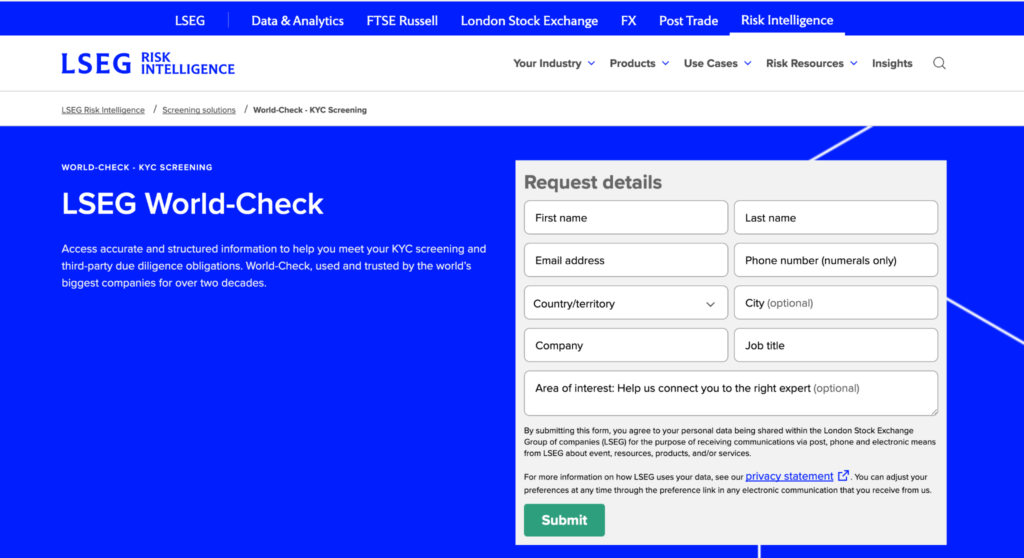
LSEG World-Check is primarily a risk-intelligence and screening product. LSEG’s coverage includes sanctions, PEPs, close associates and family members, adverse media, regulatory and law-enforcement lists, state-owned entities, UBO data, and payment-screening information. World-Check One and World-Check On Demand support different delivery models, including API access into other workflows.
Users praise the breadth of the data, export options, customization, and its usefulness for international banking. They also describe the interface as overwhelming, the product as difficult to learn, and the licensing model as something buyers need to understand carefully. Customer service scores are on the lower side.
| Pros | Cons |
|---|---|
| Broad risk data and useful coverage for international banking | Interface can feel overwhelming and require training |
| Flexible access and export options | Value for money and customer service score below the overall product rating |
Best for: Banks, insurers, fintechs, gaming firms, and regulated companies that need a recognized risk-data source.
Test before buying: Coverage in your markets, list-update timing, match-quality controls, API limits, license entitlements, and the monitoring or case platform that will sit around the data.
6. Quantexa
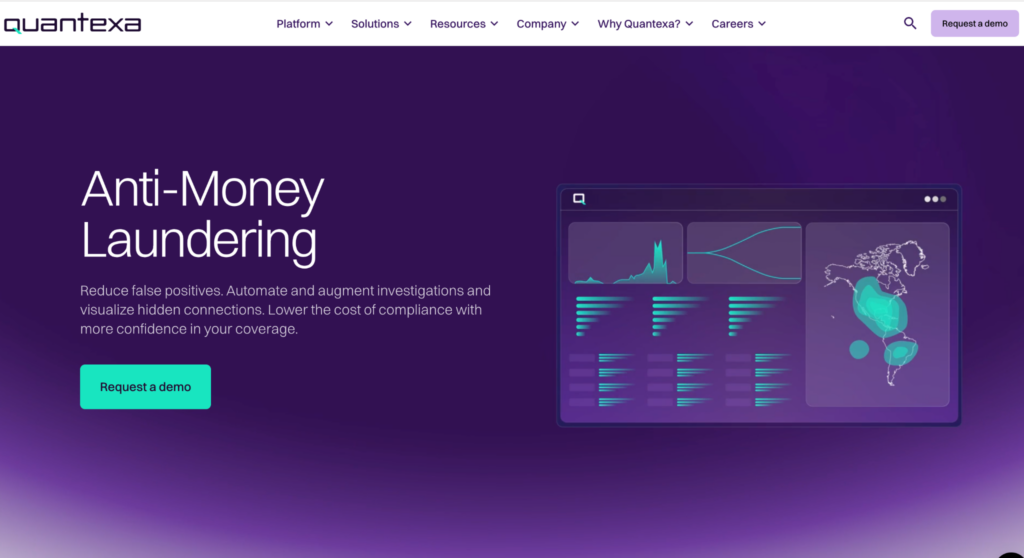
Quantexa is built for organizations that need to connect people, companies, accounts, transactions, and external records before deciding how risky a relationship is. Its AML product uses entity resolution, contextual monitoring, network analysis, and investigation tools to expose relationships that disappear when each record is viewed separately.
The review insights praise entity resolution, relationship analytics, fraud and risk capabilities, and enterprise scale. The objections are business and operational. Some of the points mentioned by reviewers are expensive licensing, complex setup, extensive onboarding, and significant skilled-resource requirements.
| Pros | Cons |
|---|---|
| Powerful entity resolution and relationship analytics | Licensing can get costly across use cases |
| Enterprise fraud, risk, and contextual analytics | Skilled resources required for setup and operation |
Best for: Larger banks and financial groups struggling with fragmented data and a serious desire to analyze connected entities.
Test before buying: Data quality, entity-match accuracy, graph explainability, model governance, implementation ownership, and the cost of adding another use case.
7. Feedzai
Feedzai’s AML Suite brings transaction monitoring, watchlist screening, and case management into its RiskOps platform. It also provides sanctions and PEP screening, audit trails, alert prioritization, and support for global AML requirements.
Reviews praise machine learning, explainability, documentation, automation rules, flexible data handling, and historical-data backfill. The caution is about operating the flexibility well. Reviewers say complex or time-sensitive support can be slow, and one review says the platform’s power requires strong governance and expertise.
| Pros | Cons |
|---|---|
| Strong machine learning, documentation, and explainability | Support depth and responsiveness can disappoint during difficult cases |
| Flexible data handling and automation rules | Flexibility creates governance and implementation work |
Best for: Banks, payment service providers, and financial institutions monitoring large volumes of transactions and events.
Test before buying: Data model, model explanations, alert thresholds, support escalation, historical backfill, and who owns rule and model governance.
8. Nasdaq Verafin
Nasdaq Verafin is a cloud-based BSA/AML and financial crime management solution for financial institutions. It also provides transaction monitoring, customer profiles, historical behavior, cross-institutional analysis, case management, SAR & CTR reporting, and watchlist scanning. It supports use cases such as structuring, funnel accounts, human trafficking, and terrorist financing.
Reviewers like the cloud integration, behavior-based analytics, ease of use, reduction in false positives, and exam readiness. A public forum discussion on r/AMLCompliance paints a less cozy picture, noting limited backend visibility, time-intensive integration, limited customization, and an outdated interface.
| Pros | Cons |
|---|---|
| Integrated cloud system and behavior-based analytics | Practitioner discussion reports integration and backend-visibility problems |
| Reviewer cites ease of use, false-positive reduction, and exam readiness |
Best for: North American financial institutions that want transaction monitoring, information sharing, investigations, and BSA/AML reporting together.
Test before buying: Data access, integration ownership, custom reports, scenario configuration, audit evidence, and the exact support available to your technical team.
How to pick the best AML provider for your business
The vendor should come after the workflow. FATF calls a risk-based approach the cornerstone of its recommendations, so start with the risks your organization must control most carefully. Write down what your analysts do today, including the parts everyone pretends are temporary.
| Evaluation step | What to measure |
|---|---|
| Map the controls | Screening, KYB, monitoring, investigation, escalation, SAR/STR/CTR preparation, and record keeping by jurisdiction |
| Replay real cases | Clean customers, true alerts, false positives, complex ownership, repeat payments, and incomplete records |
| Count analyst effort | Alerts per analyst, time to disposition, manual searches, handoffs, escalations, and rework |
| Test change management | A compliance user creates, backtests, approves, and publishes a rule without waiting for a custom development project |
| Check the evidence trail | Source data, timestamps, rule versions, reviewer actions, decisions, and exported reports |
| Price the real deployment | Data, searches, entities, transactions, users, modules, APIs, professional services, training, and tuning |
A vendor demo shows the happy path. So, during evaluation, you should spend time on the awkward cases where the cost appears.
Frequently asked questions
What is the best AML software for a bank?
If the key problem is onboarding companies and identifying their owners, then Know Your Customer is the best fit. If you require fraud signals and AML checks in the same workflow, then SEON is worth a look. If data screening is the missing piece, however, LSEG World-Check and LexisNexis Bridger Insight XG make more sense. Don’t assume a fintech label means fast deployment. Double-check for API accessibility, event handling capacity, pricing affordability, and support.
What is the difference between KYC, KYB, and AML software?
KYC means knowing and verifying an individual customer. KYB means knowing and verifying a business, including its registration, ownership, and control. AML software is the wider category covering due diligence, screening, transaction monitoring, investigations, and reporting. A KYB platform can be excellent at corporate ownership and still need a separate transaction-monitoring system.
How much does AML software cost?
Most enterprise vendors price after reviewing your volume and required modules. The bill may depend on searches, monitored entities, transactions, users, API calls, data packages, implementation, or reporting. Ask for a quote using your expected volume and include training, tuning, support, and data migration. “Per verification” is not a complete pricing model.
Can AML software replace a compliance team?
No, it can automate checking, prioritize alerts, link records, and keep evidence. People still set the risk appetite, look into questionable activity, decide when to file a report, and how to answer regulators.
