


Across Asia-Pacific, regulators and financial institutions are placing renewed emphasis on Know Your Business (KYB) as they respond to rising financial crime risks, complex cross-border structures, and fast-evolving virtual asset markets. A central challenge is the accurate identification of Ultimate Beneficial Owners (UBOs) behind layered, often opaque corporate entities. In this context, AI-powered UBO mapping is emerging as a key capability for KYB teams, promising faster, more accurate insights into ownership and control whilst reducing manual workload and operational risk.
1. Why UBO Mapping Is So Difficult in APAC
APAC is home to a dense web of corporate structures that frequently span multiple jurisdictions, including offshore centres such as the British Virgin Islands and the Cayman Islands, as well as onshore hubs like Singapore, Malaysia, Thailand, the Philippines and various ASEAN markets. Many entities use multi-layered holding companies, nominee arrangements, and cross-shareholdings, which can obscure the individuals who ultimately own or control a business.
Traditional KYB processes often rely on manual reviews of company registries, corporate documents, and shareholder registers. Analysts must trace ownership chains step by step, reconciling different languages, document formats, and legal standards. This work is time-consuming, error-prone, and difficult to scale, especially when institutions are onboarding large numbers of corporate clients or must refresh their KYB files frequently. As regulators in the region place greater emphasis on beneficial ownership transparency, firms face growing pressure to improve both the speed and depth of their UBO analysis.
2. What AI-Powered UBO Mapping Actually Does
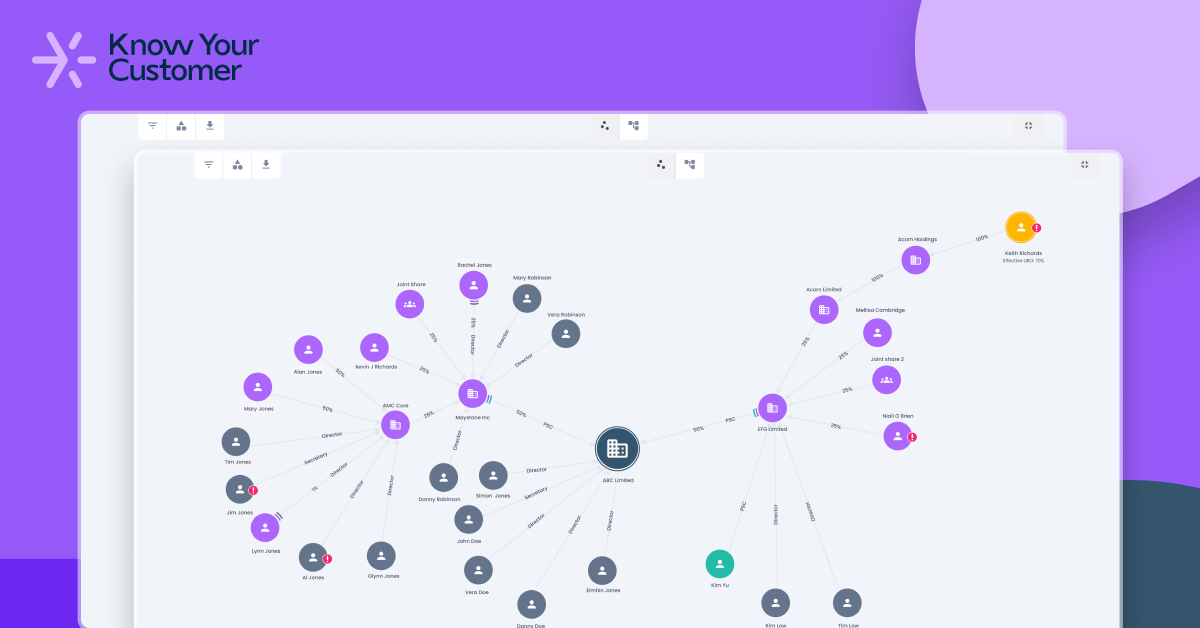
AI-powered UBO mapping applies technologies such as natural language processing (NLP), graph analytics, and machine learning to automate the unwrapping of corporate structures. Instead of manually constructing ownership trees, systems ingest registry extracts, corporate filings, shareholder lists, and other data sources, then automatically identify entities, link relationships, and calculate ultimate ownership percentages based on defined thresholds.
These tools can normalise and standardise data across jurisdictions, detect patterns that indicate potential nominee or circular ownership, and flag inconsistencies or gaps that warrant further investigation. In some implementations, AI models also cross-reference sanctions lists, adverse media, and PEP databases to highlight high-risk individuals or entities connected to the ownership structure. The outcome is a visual and machine-readable representation of who ultimately owns or controls a customer, produced in a fraction of the time required by manual methods.
3. Efficiency Gains for APAC KYB Teams
For KYB teams in APAC, the most immediate benefit of AI-powered UBO mapping is speed. Automated analysis can reduce the time needed to understand a complex structure from days to minutes, enabling faster onboarding decisions and more responsive periodic reviews. This is particularly important in competitive markets such as Hong Kong and Singapore, where financial institutions and fintechs are under pressure to balance robust compliance with smooth customer experience.
In addition to speed, AI can significantly improve consistency. Rule-driven and model-based approaches apply the same logic to every case, reducing the variability associated with human judgement on routine tasks. This leads to more standardised assessments, clearer audit trails, and easier demonstration of compliance to regulators. At the same time, automation frees experienced analysts to focus on genuinely complex or high-risk cases, rather than spending time on repetitive data gathering and manual diagramming.
4. From Point-in-Time Checks to Ongoing Monitoring
Another important impact of AI-enabled UBO mapping in APAC is the shift from static, point-in-time ownership checks to more dynamic monitoring. When KYB processes are largely manual, most institutions focus on initial onboarding and periodic reviews, with limited capacity to react quickly to interim changes in ownership or control. AI systems, combined with continuous data feeds from registries and other sources, can monitor for changes in directors, shareholders, or share capital and automatically re-run UBO calculations when triggers occur.
This event-driven approach supports regulatory expectations for ongoing due diligence and helps institutions react more quickly to emerging risks. For example, when a new director with political exposure is appointed or a sanctioned individual becomes linked to an ownership chain, the system can generate alerts for further review. This kind of continuous oversight is increasingly relevant as APAC regulators focus on strengthening beneficial ownership transparency and expect firms to maintain up-to-date knowledge of their corporate customers.
5. Data Quality, Governance, and Regulatory Expectations
Despite the benefits, AI-powered UBO mapping is not a shortcut around regulatory requirements. Its effectiveness depends heavily on the quality and breadth of underlying data. In APAC, corporate registry information varies significantly by jurisdiction in terms of accessibility, detail, and update frequency. Institutions must therefore invest in robust data sourcing strategies, including direct connections to official registries, trusted third-party providers, and well-governed internal datasets.
Regulators are also paying close attention to how firms deploy AI within compliance functions. Supervisory expectations increasingly emphasise explainability, auditability, and human oversight. KYB teams must be able to explain how an AI system arrived at a particular ownership view, ensure that models are appropriately validated, and maintain clear controls around when and how human reviewers intervene. When implemented thoughtfully, AI becomes an enabler of regulatory objectives: improving transparency, strengthening risk management, and reducing the likelihood that complex structures can be used to hide illicit activity.
6. Practical Steps for APAC Institutions
For banks, fintechs, virtual asset providers, and other regulated firms in APAC, adopting AI-powered UBO mapping should be approached as an incremental enhancement to the existing KYB framework, not a wholesale replacement. Practical steps include:
- Assessing current KYB pain points, particularly around complex structures, cross-border customers, and turnaround times.
- Ensuring reliable access to official registry data and other authoritative sources in key APAC markets and relevant offshore centres.
- Piloting AI-enabled UBO mapping on a defined segment (such as higher-risk or cross-border corporates) to measure impact on speed, accuracy, and analyst workload.
- Embedding clear governance: documented model rules, human review thresholds, and audit trails that can be shared with internal audit and regulators.
Conclusion
AI-powered UBO mapping is rapidly becoming a cornerstone of efficient KYB in APAC. By automating the analysis of complex ownership structures, it helps institutions respond more effectively to regulatory expectations, reduce manual effort, and gain a clearer view of who they are ultimately doing business with. Firms that combine high-quality registry data, well-designed AI tools, and strong governance will be better placed to manage risk, support growth across the region, and demonstrate to regulators that beneficial ownership is being understood and monitored in a rigorous, scalable way.
This is precisely where Know Your Customer Limited’s platform is designed to add value. With one of the widest coverages of real-time registry connections globally (over 140 countries), compliance teams can source official company data directly from primary registries rather than relying on static or secondary sources. AI-powered document reading capabilities then extract and standardise key information from those official filings, forming the foundation for accurate, automated UBO and shareholder mapping across borders.
On top of this data layer, fully configurable risk features and workflow capabilities allow institutions to tailor KYB journeys to their own policies, risk appetite, and regulatory obligations, whether in a single APAC market or across multiple jurisdictions. Delivered as a cloud-native solution, the platform offers the scalability and flexibility needed to support both high-volume onboarding and more targeted, complex reviews without adding unnecessary operational overhead.
By combining AI-driven UBO mapping with real-time registry access and configurable workflows, Know Your Customer enables APAC institutions to move beyond manual, fragmented KYB and towards a model that is faster, more consistent, and better aligned with the region’s evolving regulatory landscape.
