


Gone are the days when a DUNS and Bradstreet number was the gold standard for verifying a customer or onboarding a vendor. Recent Trustpilot reviews show a stark contrast in its popularity, with a 1.1 rating and claims that a DUNS number takes nearly 30 working days to arrive.
While the data isn’t necessarily wrong, reviewers often say it may be outdated, as registry and status changes are collected and loaded into D&B’s database in batches. For instance, a company that dissolved last week or changed hands recently may not appear promptly.
Stale records are the major reason why teams have started looking for Dun and Bradstreet alternatives.
A stale record in the case of payment platforms and banks may result in approving a business that no longer exists. It may also cause you to miss a sanctions check for a beneficial owner who wasn’t visible at the time of verification.
The endless possibilities for things to go haywire in a regulated environment are why compliance teams now evaluate D&B against platforms built specifically around live registry data and continuous monitoring.
However, that does not necessarily mean that D&B is not the right fit for every use case out there. The right D&B alternative for your use case might hinge on the actual D&B product that you’re trying to replace. You can pick an ideal alternative by identifying the specific product line of D&B that you actively use.
What is Dun and Bradstreet and what do people actually use it for?
Dun & Bradstreet is a business data company that sells company records, credit scores, and compliance screening under one roof. To figure out which D&B product you’re using regularly, open your last Dun & Bradstreet invoice.
Somewhere on it is a product name added as a line item, and it could be one of these five:
- Hoovers: D&B’s sales intelligence database
- Finance Analytics: The credit risk product, with annual tiers listed from $1,200 to $50,000 for small business buyers
- Risk Analytics Compliance Intelligence: The KYB, UBO, and sanctions screening product
- Direct+: The API for matching and enrichment.
- DUNS number: A free nine-digit identifier that D&B has issued since 1963.
The specific product line you’ve been using from Dun & Bradstreet determines which alternative you should consider instead of a broad-scale, do-it-all D&B alternative.
| D&B product | The complaint that drives people off it | Direct alternatives |
|---|---|---|
| Risk Analytics Compliance Intelligence | Records reflect a periodic pull, not today’s registry | Know Your Customer, Middesk, Sayari, Moody’s, LexisNexis |
| Finance Analytics | Six-month-old data, tiers from $1,200 to $50,000 a year | Creditsafe, Experian |
| Hoovers | Stale contacts, expiring monthly credits | ZoomInfo, Apollo |
| Direct+ | Per-record pricing, cache rather than source | OpenCorporates, Kyckr |
| D-U-N-S Number | 30-day waits, upsells | Nothing more than government entity IDs |
What can be done about the D-U-N-S Number?
The reason why most small businesses register with D&B is that they have been issued a free D-U-N-S Number (9 digits) by D&B’s data cloud. Most negative comments on Trustpilot regarding D&B are related to the DUNS number.
The historical reason to hold one for small businesses has largely gone away, as most government organizations no longer use DUNS numbers. Instead, they generate unique entity identities. For many small businesses today, the only reason to apply for a DUNS number is to register their apps.
Google Play will not open an organization developer account without a D-U-N-S Number and tells developers to allow up to 30 days. Apple’s Developer Program requires one from companies and educational institutions, though not from individuals. Some enterprise procurement portals still request it out of habit.
None of that is affected by which data or compliance vendor you use. Get the free number if a platform demands it, ignore the $299.99 Registered Seal upsell, and treat the identifier question as separate from the vendor question.
D&B alternatives at a glance
Here’s a comparison of which product the DnB alternatives replace, along with their data model, coverage, and pricing details.
| Vendor | Replaces which D&B product | Data model | Coverage | Pricing model |
|---|---|---|---|---|
| Know Your Customer | Risk Analytics (KYB, UBO) | Live registry connections, documents fetched at verification time | 500+ registries, 153 jurisdictions | Quote, volume-based |
| Creditsafe | Finance Analytics (credit) | Proprietary credit database, 9,000+ sources | 430M+ reports, 200+ countries | Custom plan, one free report |
| Moody’s Orbis | Risk Analytics and Finance Analytics | Aggregated database with ownership links | 635M+ entities, 211 jurisdictions | Enterprise licence |
| Experian Business | Finance Analytics (credit) | Bureau credit data with corporate linkage | 225 countries and territories | Per report or subscription |
| Middesk | Risk Analytics (US KYB) | Government sources, continuously refreshed | 400+ sources, US first | Usage based |
| OpenCorporates | Direct+ (registry lookup) | Official registry data, standardized | 140+ jurisdictions | Free search, paid API |
| Sayari | Risk Analytics (ownership, supply chain) | Resolved entity graph from primary documents | 1.5B+ entities, 250+ jurisdictions | Quote |
| LexisNexis Risk Solutions | Risk Analytics (screening) | Aggregated risk data | 10,000+ sources | Quote |
| ZoomInfo | Hoovers (sales) | Contact and company database with intent data | 400M+ contacts | Seat plus credits |
| Apollo | Hoovers (sales) | Contact database with outreach tooling | 240M+ contacts | Free tier, $49 to $119 per user per month |
| Kyckr | Direct+ (registry documents) | Direct connections to official registers, documents retrieved live | 300+ registers, 100+ countries | Pay per call, no minimums |
A deep dive into 11 DnB alternatives for compliance and business verification
Listed below are 11 Dun and Bradstreet alternatives that are specifically built for compliance and business verification.
1. Know Your Customer
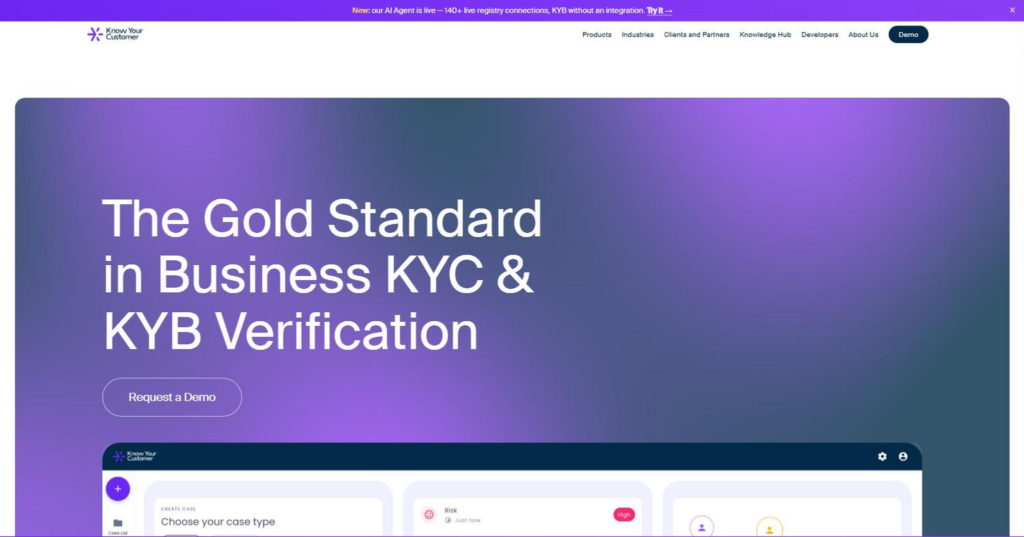
Know Your Customer is a RegTech platform built for business verification. Its KYC Data product connects directly to 500 or more local registries across 153 jurisdictions and pulls incorporation documents, shareholder filings, and director records at the moment a case is opened.
DBS Hong Kong partnered with the platform for SME account opening in March 2026, and Standard Chartered Hong Kong runs real-time company checks through it over the HKMA’s Commercial Data Interchange since July 2025.
Key features
- An AI Agent with 140+ live registry connections that runs KYB checks without an API integration, for teams that want results before engineering time is booked
- Beneficial ownership resolved as a multi-level ownership chart in addition to listing shareholders
- Identity document verification for 180 or more countries with liveness checks, so directors and UBOs are verified in the same case as the company
- Registry data partnerships with LexisNexis and the London Stock Exchange Group
Pricing: Quote-based and scales with onboarding volume and the jurisdictions you need.
Who it is for: Banks, payment firms and lenders replacing D&B for onboarding and periodic KYB review, especially where clients incorporate across several countries.
2. Creditsafe
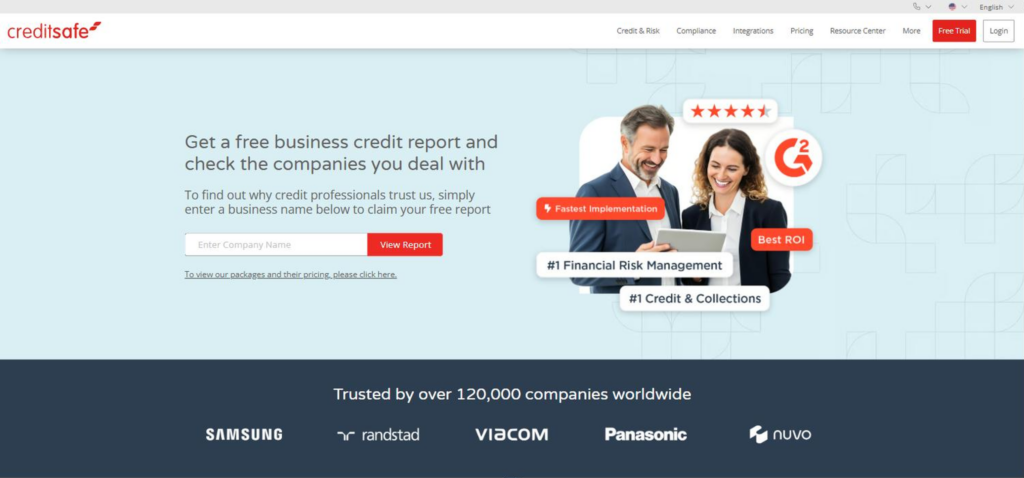
Creditsafe can be a replacement for D&B Finance Analytics, and this vendor markets against D&B most openly. It holds 430 million business reports across 200 or more countries, claims 1 million data updates a day, and delivers 99.9 percent of reports instantly. Monitoring alerts cover score changes, insolvencies, and director changes, while covering PEP and sanctions checks.
Key features
- Credit scores and recommended limits with real-time alerts on changes
- Sanctions, PEP, and enhanced due diligence screening under one login
- One free business credit report with no card details required
Pricing: Customized to usage rather than a published tier, with no long-term lock-in advertised.
Who it is for: Credit and accounts receivable teams that want a cheaper, faster credit report with light compliance screening bundled in.
3. Moody’s Orbis
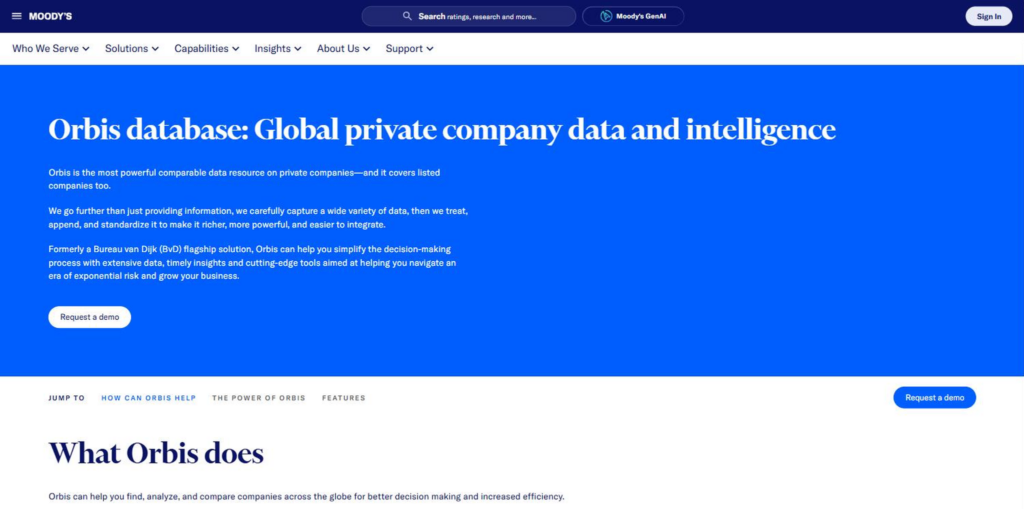
Moody’s Orbis, the former Bureau van Dijk database, is the closest thing to D&B’s data cloud in scale. Moody’s lists 635 million or more entities and 2 billion ownership links built from 170 or more data sources, and its compliance brochure puts coverage at 211 jurisdictions. Sanctions list updates reach customers within one business day. More than 99 percent of the companies it covers are private.
Key features
- Beneficial ownership calculated top-down or bottom-up at thresholds you set
- Financial scores on 40 million companies alongside 21 million risk profiles
- BvD ID, Orbis ID and LEI identifiers for entity matching
Pricing: Requires enterprise licenses.
Who it is for: Large compliance and credit teams that want one aggregated database with ownership depth and accept that aggregation means a refresh lag on some records.
4. Experian Business
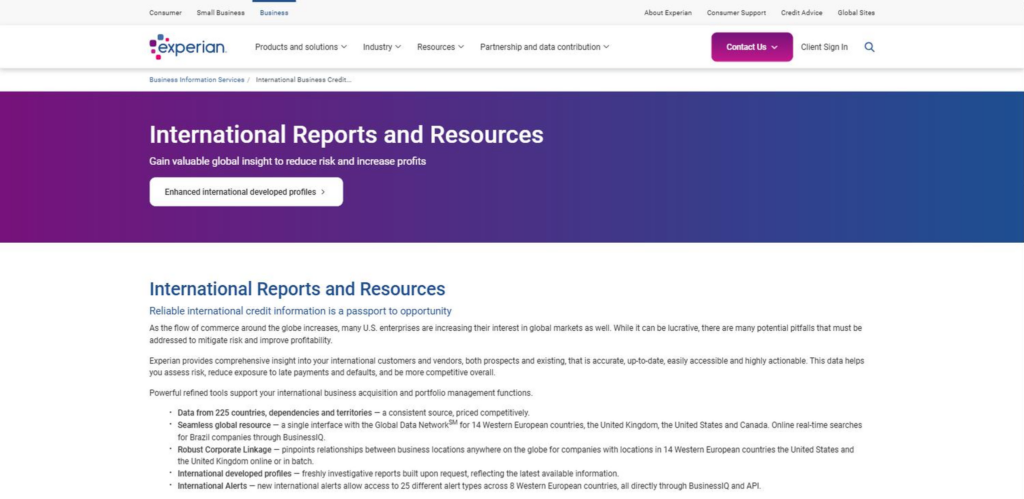
Experian is the credit bureau option for teams that already buy consumer or SMB credit from it. International reports cover 225 countries, dependencies and territories, with real-time online access concentrated in the US, UK, Canada and 14 Western European countries through BusinessIQ.
Key features
- Seven international report formats, from a small report to an extended one
- Corporate linkage across related entities in core Western markets
- 25 alert types across eight European countries via BusinessIQ or API
Pricing: Available per report or by subscription and is not published for international products.
Who it is for: Finance teams that need business credit data only and run KYB and sanctions checks somewhere else, because Experian’s business product does not include beneficial ownership tracing.
5. Middesk
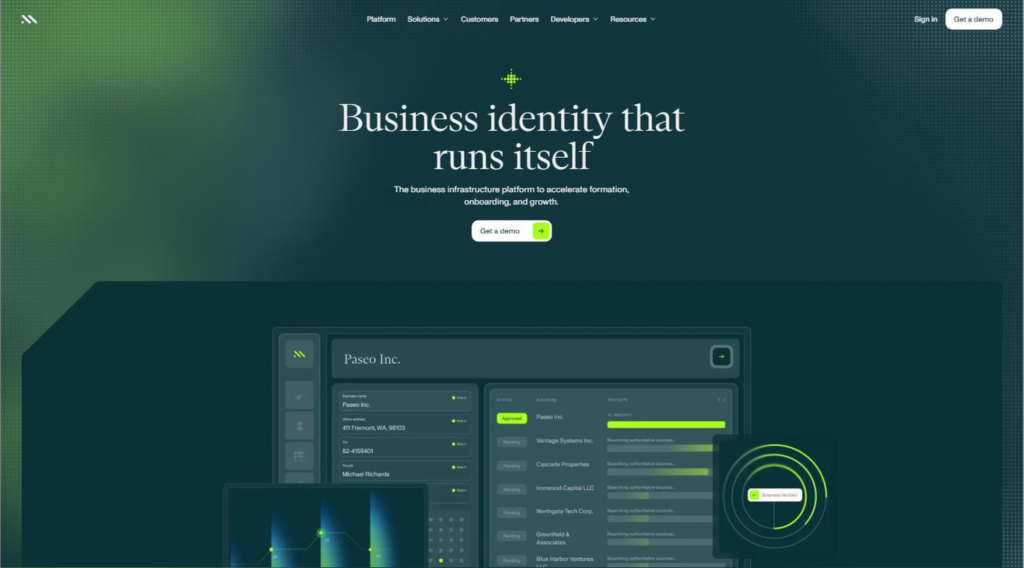
Middesk is a US-first Know Your Business (KYB) platform that aggregates data from over 400 government and authoritative sources. The platform verifies over 7 million businesses every year and claims that 10% of new US businesses verify through the platform within 90 days of incorporation. The company recently announced international verification for Canada, Europe, and APAC via the same API in 2026.
Key features
- Secretary of State, tax ID, and sanctions checks in a single API call
- Fraud signals built for underwriting and payment onboarding
- SOC 2 Type II and audit-ready decision records
Pricing: Usage-based pricing available on quote.
Who it is for: Fintechs and lenders onboarding mostly US entities that want a developer-led KYB layer rather than a compliance workspace.
6. OpenCorporates
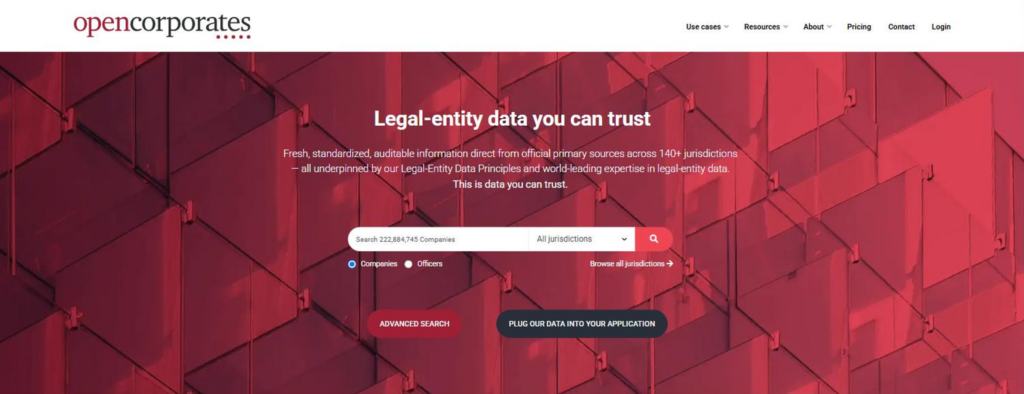
OpenCorporates is the open database of company registry records, standardized from over 140 government registries and used by 2,000 organizations, including 80 percent of the largest banks in North America and Europe. Search is free, but bulk and API access is paid.
Key features
- Standardized entity records with registry identifiers, UEI, CAGE, and NAICS codes
- Published legal-entity data principles covering provenance
- Certified B Corp with a stated mission around public access to company data
Pricing: Free for search and quote-based for API and bulk data.
Who it is for: Teams replacing D&B Direct+ for basic entity lookup and enrichment, and anyone who needs a free first pass before a paid verification. It is not a compliance workflow, and so it does not fetch original filings on demand.
7. Sayari
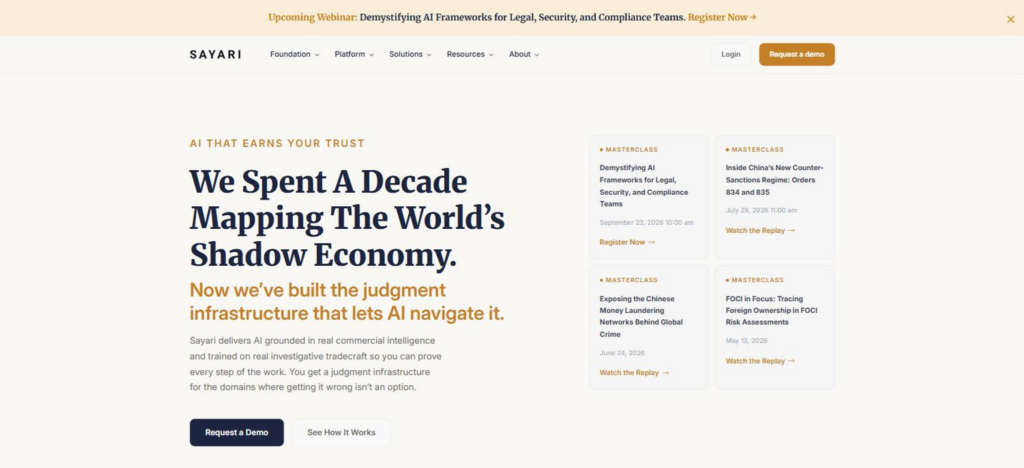
Sayari resolves 1.5 billion entities across 250 or more jurisdictions into a single graph built from primary documents, which makes it the alternative for D&B users doing supplier and ownership screening. Its public sector contracts include an $8.5 million engagement with the US Treasury.
Key features
- Cross-border ownership and control mapping, including indirect and circular ownership
- Sanctions, export control, and forced labor screening on the same graph
- Sub-second latency at transaction scale, according to one e-commerce case study
Pricing: Quote-based.
Who it is for: Trade compliance, third-party risk, and investigations teams that want ownership depth across jurisdictions D&B covers thinly.
8. LexisNexis Risk Solutions
LexisNexis Risk Solutions is the enterprise screening option, and the only vendor on this list with an independent scorecard placement to point at. Relies on the WorldCompliance Data, the database which covers millions of risk profiles ranging from global sanctions to enforcement lists, and Politically Exposed Persons (PEPs).
Key features
- Entity resolution across identity, business, and adverse media data
- Bridger Insight XG for sanctions and watchlist screening at scale
- Registry document retrieval through Kyckr, which names LexisNexis among its customers
Pricing: Quote-based with enterprise implementation timelines.
Who it is for: Tier one banks and insurers that weigh vendor selection by analyst validation and already run LexisNexis for other risk data.
9. ZoomInfo
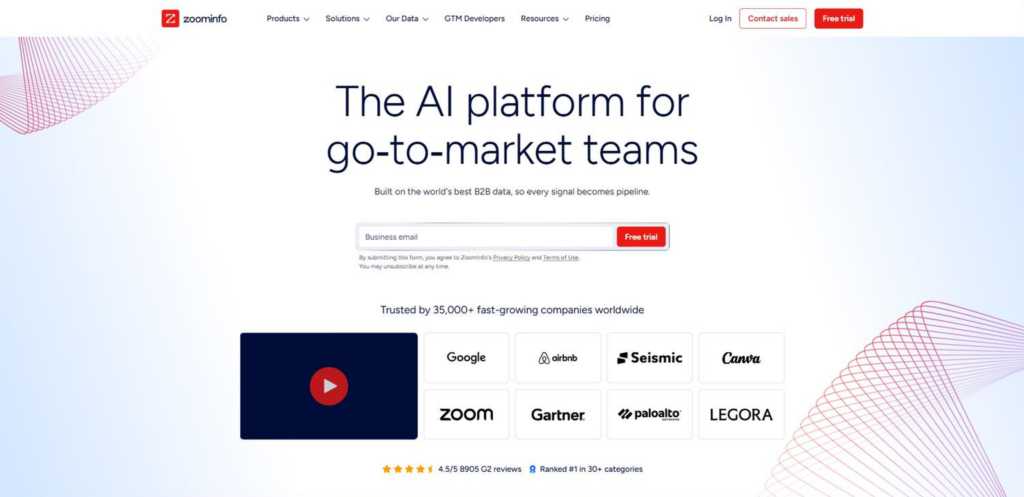
ZoomInfo is an ideal replacement for D&B Hoovers. Its own D&B comparison page cites 500 million verified contacts and 30,000 customers, with buying intent signals and org charts layered on top.
Key features
- Contact-level data with direct dials and verified emails
- Intent signals and CRM enrichment for account prioritization
- Chrome extension for prospecting from LinkedIn and company sites
Pricing: Seat-plus-credit based and quoted, which is the same complaint Hoovers users have.
Who it is for: Sales and marketing teams that need prospecting data and have no compliance or credit use case. It replaces nothing on the D&B risk side.
10. Apollo
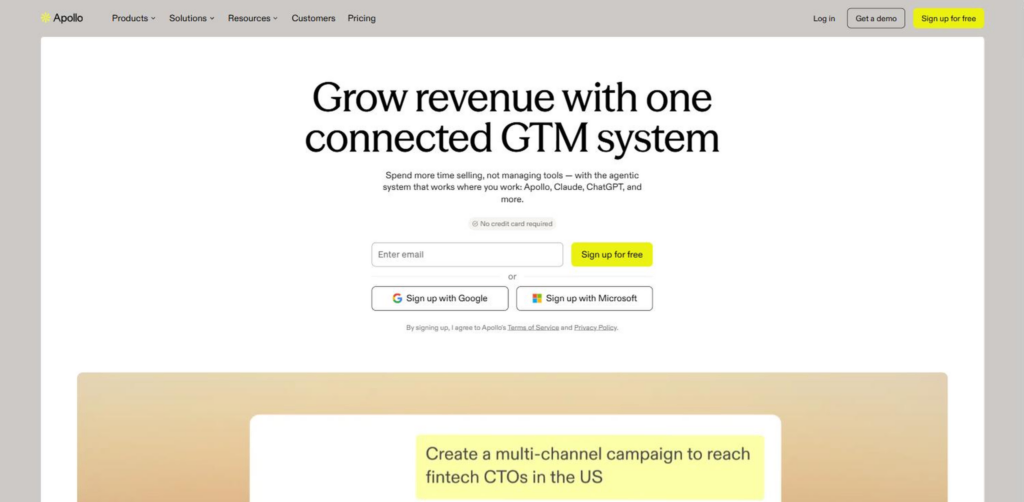
Apollo is a cheaper Hoovers replacement, with 240 million or more contacts and a free tier. Although most businesses use it more as an email marketing tool, its hierarchy data and firmographic information can come in handy.
Key features
- Free plan with 1200 credits per user per year and two active sequences
- Sequencing, dialer, and email tooling in the same product
- Chrome extension and CRM sync
Pricing: Starts at $49 per user per month
Who it is for: Small sales teams can live with thinner firmographic and hierarchy data.
11. Kyckr
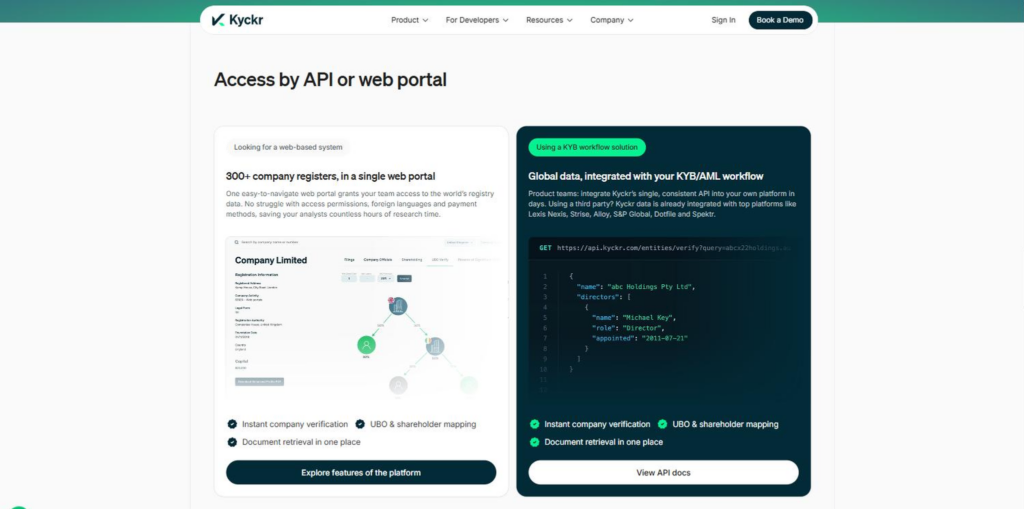
Kyckr is a registry access layer rather than a compliance workspace, and the vendor several others on this list use underneath their own product. It connects directly to 300 or more official registers across 100 or more countries, covering about 200 million companies, and retrieves the original filing in 15 minutes or less on average
Key features
- Live document retrieval from the register itself, so the filing carries the registry’s own date
- A claimed 80 percent cut in verification time against manual registry checks
- Usage-based billing with no minimums, which is the opposite of an annual D&B commitment
Pricing: Per call with no usage minimums.
Who it is for: Teams replacing D&B Direct+ that already run their own onboarding workflow and want the registry document, not a summary, delivered into it by API. It has no sanctions screening and no case management, so it remains as a registry access layer.
How to choose a Dun & Bradstreet alternative
Start with the invoice and find the D&B product line you actually pay for and shortlist only from that row of the table above.
Then run a parallel test that targets the specific failure that sent you looking. If the problem was stale records, take 50 companies you onboarded last quarter, run them through both systems, and count how many show a different legal status, director list, or shareholder on the new platform.
If the problem was cost, model the new vendor at your volume 12 months out rather than at pilot volume, because per-lookup pricing behaves very differently at 10,000 checks a month than at 500. Ask each vendor when a record was last pulled from its source. A database that cannot answer that for a single company is a periodic database, whatever the marketing page says.
Frequently asked questions
What is the best Dun & Bradstreet alternative for business verification?
Know Your Customer for cross-border KYB with live registry documents, Middesk for US-only onboarding, and Moody’s Orbis or Sayari where ownership depth across many jurisdictions matters more than document retrieval.
What is the best Dun & Bradstreet alternative for business credit reports?
Creditsafe and Experian Business. Creditsafe bundles sanctions and PEP checks with the credit report. Experian does not, but has wider international credit coverage.
Which Dun & Bradstreet alternative is cheapest?
Apollo for contact data, with public pricing from free to $119 per user per month. For credit, Creditsafe’s one free report is the cheapest way to test data quality before buying anything.
Can I replace D&B for compliance and keep it for sales?
Yes, and many teams do. The compliance and credit products on this list do not include prospecting data, so a split is normal.
