


Sumsub was built for people-first identity checks.
As the scope of verification moves to include KYB (Know Your Business), things may get complicated. KYB is the process by which financial institutions and other organizations verify the existence, registration details, and ownership structure of a business.
Initially, you may notice an increase in global registry data limitations or difficulty identifying beneficial owners in complex corporate structures.
These may not be deal-breakers at first.
But over time, verifying companies and their real owners without manual intervention can become hectic. As a result, you may end up hunting for Sumsub alternatives that can replace your existing processes with minimal disruption.
To assist you in your search, we’ve looked at the seven strongest Sumsub alternatives based on user reviews on third-party review sites such as G2, Capterra, Gartner, and Trustpilot.
But before you get started with the evaluation, determine what capabilities you need the most to fulfill your KYB needs. Decide whether you need original registry documents on demand. Or if a one-off copy of some company’s official filings and reports without a recurring subscription would be enough. Whatever your requirements are, jot them down clearly.
Top 7 Sumsub alternatives at a glance
Some of the strongest Sumsub alternatives in this list were built around company verification as the core. They come with features ranging from AML and watchlist screening to biometric and liveness checks with global coverage.
| Vendor | Best for | KYC (individual) | KYB (business) | AML and watchlist screening | Biometric and liveness check | Coverage |
|---|---|---|---|---|---|---|
| Know Your Customer | Corporate KYB and cross-border onboarding | Yes, strong | Yes, strong | Yes | Yes | 140+ countries |
| Shufti Pro | Global KYC and KYB across many jurisdictions | Yes | Yes | Yes | Yes | 240+ countries |
| Persona | Customizable no-code verification workflows | Yes, strong | Yes | Yes | Yes | 200+ countries |
| Veriff | High-volume biometric identity verification | Yes, strong | Partial | Partial | Yes, strong | 230+ countries |
| Entrust IDV (formerly Onfido) | Enterprise document and biometric verification | Yes, strong | Partial | Partial | Yes, strong | Broad enterprise coverage |
| Jumio | Identity verification bundled with fraud detection at enterprise scale | Yes, strong | Partial | Yes | Yes, strong | Broad enterprise coverage |
| iDenfy | Affordable KYC and KYB with human backup review | Yes | Yes | Partial | Yes | Broad, hybrid AI plus human |
Why do teams look for alternatives to Sumsub?
Sumsub started as a people-centric verification product, and as time went by, KYB features were added as a bolt-on. These capabilities may be enough when you’re focused on individual verification with occasional business account runs. However, as verification needs scale to include business-related tasks, Sumsub’s capabilities may not stretch to cover it.
And, according to third-party reviews, it is the small things that add up and make financial institutions look for an alternative.
1. Pricing
Price is a factor that pops up frequently in third-party reviews, with users claiming that prices are too high for small, growing firms. Also, as verification volume grows, firms have a hard time forecasting their final cost well in advance.
Sumsub’s verification-focused billing model may not work for industries with high rejection rates, such as crypto and gaming businesses, which may end up paying for sessions that do not convert.
2. Support
A few user reviews mention occasional website downtime, and the first-line support team was either unresponsive or lacking in deeper product knowledge.
3. Reliability
Some reviews mention high incident rates with false positives, which grew into a huge concern over the accuracy of documents approved using the platform.
4. Platform limitations
Users say that Sumsub’s workflow builder has some room for improvement. A few claim that when they tried to create conditional workflows to fetch data from forms, they found them to be out of scope.
5. KYB Gaps
As we’ve already mentioned, Sumsub’s KYB gap becomes a problem when your verification process is centered around companies and their beneficial owners.
How to evaluate Sumsub alternatives?
Before you start ranking Sumsub alternatives by their capabilities, take a moment to introspect your actual KYB needs and the major problem that you’re facing with Sumsub right now.
- Would a core KYB solution that was built around business verification solve your current challenges?
- Do you require deep screening in addition to the one-time sanctions and PEP check that occurs at onboarding?
- Are you looking for continuous KYB monitoring that flags businesses and beneficial owners as their risk scores rise?
- Should the biometric and liveness layer in your KYB application hold up against deepfakes and injection attacks that go well beyond merely catching photo swaps?
- Would a per-verification pricing model be beneficial for your business? Or would it bloat your subscription rates due to the high rejection rate in your niche?
- Is there a dire need for human reviews in case of ambiguity, or would you prefer a fully automated check without any fallbacks?
- Does the platform of your choice cover registries of specific countries and entities that your business onboards?
Answering these questions will help you understand where your KYB process is breaking today and what functionalities can help you fix those.
The 7 best Sumsub alternatives in 2026
To help you in your search, we’ve captured what each alternative in this list says about itself, what it’s actually built to do, and what real users say once they’ve been in the product long enough to have an opinion worth trusting.
1. Know Your Customer

Know Your Customer builds its platform around the exact KYB gap Sumsub users flag. It is a cloud-based compliance ecosystem built for corporate onboarding and periodic review. Its global company records component pulls KYB reports and original registry documents on demand. Its KYB API connects seamlessly to live registries across more than 140 countries, so you never have to email a foreign corporate registrar to confirm a shareholder structure.
Users who deploy its AI Agent for document review and its KYC Data registry connections have seen onboarding times drop sharply, reducing manual review costs. Its client list includes DBS Bank, Standard Chartered, and Coda Payments. It also partners with LexisNexis and the London Stock Exchange Group for registry data.
Pricing
Know Your Customer provides a custom quote scaled to onboarding volume and the number of jurisdictions in which your business needs registry access.
- Real-time registry connections across 140+ countries
- Continuous KYB monitoring in addition to scheduled checks
- AI-driven document reading built for corporate structures
| Pros | Cons |
|---|---|
| Trusted globally with feature-packed capabilities | Some users mention that a lack of open access to all registered users is a bottleneck |
| From the very first contact, the KYC team is said to be knowledgeable and helpful | Comparatively small public review base when compared to other solutions in the list |
| Strong fit for KYB-heavy workflows like SME lending |
Best for: Financial institutions, lenders, and service providers seeking in-depth business verification.
2. Shufti Pro

Shufti Pro stands out for its deployment flexibility, offering on-premises, private cloud, or SaaS options, depending on the client’s data residency requirements. The system is trusted by 2,000 enterprises across 240+ regions. Its proprietary AI stack, which comprises an AI journey builder, co-pilot, and MCP integration, can detect deepfakes using multi-stream signals.
- Individual identity (KYC) and business verification (KYB) in the same platform
- Offers various verification methods ranging from AML screening to liveness detection
- Mobile-first user experience in onboarding and KYC flows
Pricing
Shufti Pro doesn’t list public pricing and may depend on the unique deployment and data residency needs of a business.
| Pros | Cons |
|---|---|
| Responsive support and user-friendly interface | Room for improvement in business intelligence reporting |
| Speed of verification and high accuracy | Recurring issues and lack of consistency in issue resolution |
| Quick initial setup |
Best for: Global businesses across fintech and e-commerce that want KYC and KYB automation without a large manual review team.
3. Persona

Persona offers the most adaptable way to verify real people and real businesses online. It is built from modular components that a compliance team assembles into its own workflow. It has verified roughly a billion identities and stopped hundreds of millions of fraud attempts. It has earned analyst recognition, including a 2026 Gartner Magic Quadrant leader placement for identity verification.
- No-code workflow builder for verification logic
- Modular KYB components alongside individual KYC
- Real-time selfie and biometric verification
Pricing
Persona’s pricing is quote-based and scales with the modules a team turns on based on what they need to build their verification stack.
| Pros | Cons |
|---|---|
| Excellent identity verification management with a quick setup | Occasional problems in determining the legitimacy of submitted documents |
| Helps businesses comply with regulations and also authenticate employees | Sometimes the platform flags real users as fake, raising manual reviews |
| Has a strong user community |
Best for: Startups and mid-market teams that want to build and adjust their own verification flows without a lot of engineering overhead.
4. Veriff
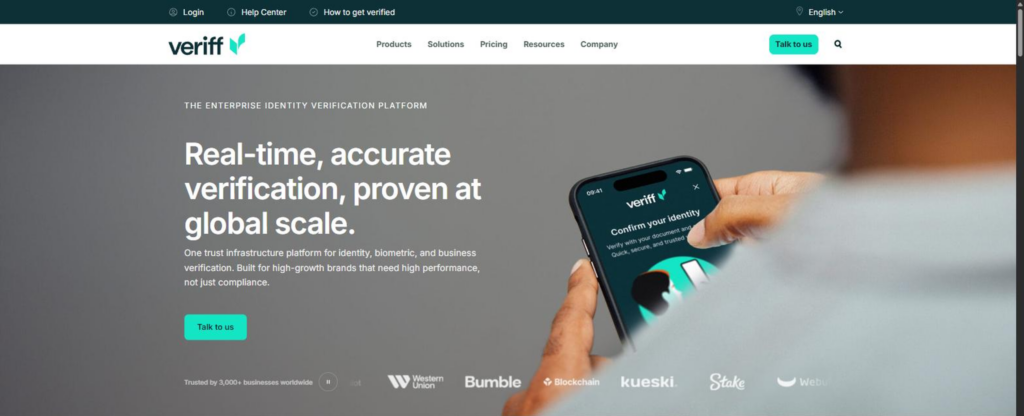
Veriff is an enterprise identity verification platform built on proprietary technology. It builds its core biometric and document models in-house. For adjacent checks like AML, it clearly names the specialist partners it relies on. It has an average decision time of 6 seconds and an accuracy of 99.6 percent, a claimed rate meant to cut false declines, across more than 12,500 document types and 230-plus countries and territories.
- Support for 12,500+ ID document types
- Built-in biometric and liveness detection layer
- Named specialist partners for adjacent checks like AML
Pricing
Although Veriff doesn’t publish pricing publicly, some reviews flag it as higher than other competitors, making it a sticker shock for startups running lean volume.
| Pros | Cons |
|---|---|
| Ability to protect data while managing logins to prevent unauthorized access | Complex setup process |
| Supports 12,000+ types of ID documents from 230+ countries or territories | Limited customization capabilities |
| Strong anti-fraud layer with effective detection |
Best for: Businesses that need fast, biometric-heavy identity verification at high volume.
5. Entrust IDV (Formerly Onfido)

Onfido was acquired by Entrust and now sits inside its broader identity security portfolio as Entrust IDV. By making verified identity the anchor, this tool powers passkeys and step-up authentication at every high-risk moment. Focusing on fraud detection, the tool catches deepfakes and injection attacks through AI biometrics and a dedicated fraud research lab that keeps the detection engine up-to-date.
- Document authentication paired with facial biometric checks
- Deepfake and injection attack detection backed by a dedicated fraud lab
- Identity reuse across onboarding, authentication, and step-up verification later in the relationship
Pricing
Entrust IDV is enterprise-focused and quote-based.
| Pros | Cons |
|---|---|
| The layout and easy-to-use dashboard, along with its verification efficiency | Expensive, particularly challenging for startup companies facing budget constraints |
| Quick onboarding while maintaining strong access controls | Outdated documentation, inconsistent SDK responses, and limited testing environments |
| Excellent support team that’s always happy to help with quick responses | The document check can take longer than other resources to show a status |
Best for: Larger financial institutions and lending platforms that want an established enterprise vendor with a long track record.
6. Jumio
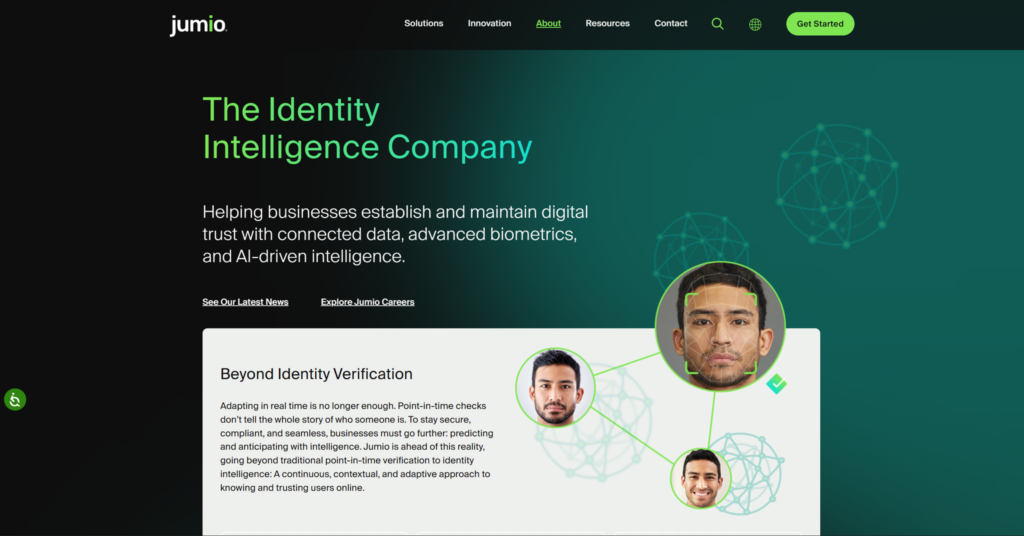
Jumio offers continuous identity intelligence built around its Identity Graph, where millions of known identities are cross-referenced to surface patterns that a one-time document check would miss. The system has processed over a billion transactions since its inception and has the capability to handle roughly 120 transactions per second. Also, it has more than 300 patents behind its biometric and liveness detection.
- AI-powered document and biometric verification
- Proprietary identity graph cross-referencing known fraud patterns
- Built for global, multi-market compliance monitoring
Pricing
Jumio doesn’t publish pricing. However, the cost can become more of a factor as verification volume climbs, so model your expected volume before requesting a quote.
| Pros | Cons |
|---|---|
| Fast and reliable ID scanning and biometric verification | Users may occasionally have to retry verification when image quality is low |
| AI-driven verification reduces manual reviews considerably | Pricing increases with the volume |
| Its API integrates well with existing tools | Information extraction is not 100% accurate for names with special characters |
Best for: Mid-market and enterprise financial institutions that need identity verification and fraud detection from the same vendor.
7. iDenfy
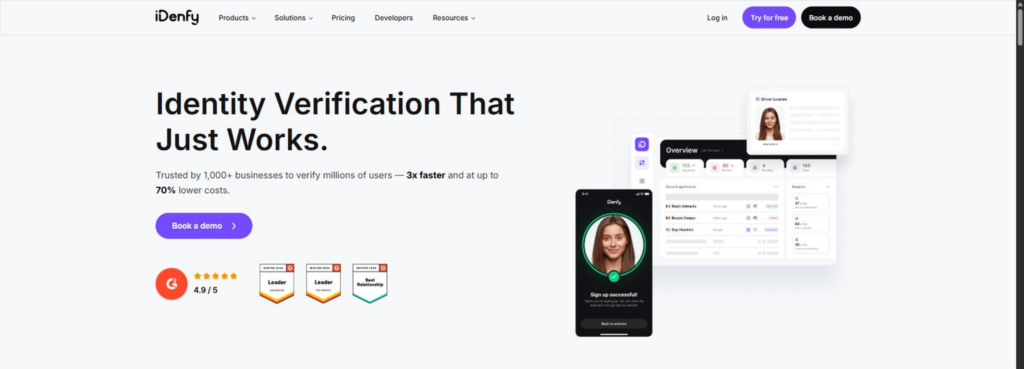
iDenfy is trusted by 1,000+ businesses, with its verification running roughly 3 times faster and saving up to 70 percent of user onboarding costs. The hybrid model is its crown jewel. Its AI handles the clean scans, and a 24/7 human review team catches the ambiguous ones within minutes. The system bills only for successful verifications, and failed attempts don’t count.
- Hybrid AI plus human review, live around the clock
- KYC and KYB coverage in the same platform
- Pay-per-successful-verification pricing
Pricing
iDenfy’s stated model is pay-per-successful-verification, so it applies to volume and bundled capabilities.
| Pros | Cons |
|---|---|
| The system reliably flags suspicious documents without creating an excessive number of false positives | Users experience verification issues due to blurry documents slowing down the process, leading to manual reviews |
| Verification is quick, and users rarely report problems completing it | Dashboard layout can feel a bit crowded when managing multiple verification queues at once |
| Hybrid verification framework backed by 24/7 human review experts while the AI-powered mapping handles clean scans immediately |
Best for: Fintech, crypto, and iGaming platforms that want AI speed backed by human safety.
How to pick the right Sumsub alternative
If KYB is your actual pain point, start with Know Your Customer, Shufti Pro, or iDenfy. All of these platforms treat business verification as native, which is the exact thing Sumsub reviewers say is missing.
If your volume is almost entirely individual identity checks along with some business reviews and speed is what matters most, Veriff, Entrust IDV, and Jumio are built specifically for that.
If your rejection rate runs high, especially for crypto exchanges and gaming platforms, iDenfy’s pay-per-success billing directly answers the cost complaint that sends people away from Sumsub in the first place. Ask every other vendor on this list how they bill before assuming the switch saves money.
Remember, switching identity vendors is not a small project. Whichever name ends up on your contract, run it against a batch of your actual historical applicants, the messy ones, before you commit.
How to migrate from Sumsub
Once you’ve picked a Sumsub alternative, you need to plan the migration well before executing it:
- Run the new platform in parallel to Sumsub while diverting a slice of traffic there
- Once the new KYB tool sustains the traffic, map verification steps and risk rules
- Integrate the new platform’s API and test it against a batch of your historical applicants
- Avoid moving all customers at once; shift data progressively by segment/region
- Once the new platform meets the accuracy and false-positive threshold, you can decommission Sumsub
Also, check the billing model of your chosen platform before you initiate the migration.
Frequently asked questions
What is the best Sumsub alternative for business verification?
Know Your Customer, Shufti Pro, and iDenfy all build KYB as a core feature, which matters if verifying the company behind an account is your bigger problem than verifying the person.
Is Sumsub good for individual identity verification?
Yes. Most of the complaints that push people toward alternatives are about pricing, support response times, and the depth of business verification. At its core, Sumsub’s person verification is strong.
Which Sumsub alternative is cheapest for high rejection rate industries?
iDenfy bills only for successful verifications, which directly addresses the billing complaint crypto and gaming platforms most often raise about per-attempt pricing models like Sumsub.
Do Sumsub alternatives cost less overall?
It depends on the vendor and your rejection rate. Sumsub bills per completed verification, which gets expensive fast for industries with high rejection rates. Some alternatives on this list get flagged in their own reviews for similar pricing pressure, so ask about the billing model directly and verify it before signing the contract.
What is the Sumsub controversy?
There were several allegations circulating about Sumsub ranging from concealed ultimate beneficial structure to the platform being a Russian project or having a presence in Russia, all of which were clarified by an official statement. In most controversies, it appears that authors never approached Sumsub for a statement.
