


In 47 US jurisdictions, depending on how the LLC is structured, an owner can legally keep their name off the record. FinCEN recently removed the federal beneficial-ownership reporting requirement making the state-level anonymity gap more consequential today. This gap is exploited by threat actors to set up a company whose real owner never appears on paper, then run money through it like any other legitimate business.
The World Bank’s Stolen Asset Recovery Initiative study of 150 major corruption cases worldwide substantiates this claim. The study found that in the vast majority of cases, someone hid the money inside a corporate vehicle specifically designed to make the real owner disappear on paper. A shell company, a trust, a chain of ownership three or four layers deep.
That’s the entire reason KYB (short for know your business) exists as a discipline separate from KYC. KYB goes beyond verifying the person who signs a form to confirm the company that owns it and the actual people who own and control it.
This list covers seven KYB providers worth shortlisting in 2026, picked for how deep their business verification actually goes.
How we picked these providers
This list was ranked neither by marketing budget nor by search ad presence. Each provider listed here had to clear three bars:
- Have a real registry or identity data behind its claims.
- Run workflows that trace ownership beyond company name and address.
- Enough public clout, such as third-party reviews, client names, or embedded partnerships.
A couple of names here have limited independent review coverage, and we note that clearly in their respective sections.
What does a KYB provider actually do?
A KYB provider verifies that a business is real, legally registered, and actually owned by the entity it claims to be owned by, then continuously monitors to flag any emerging risks.
In reality, the KYB provider’s system pulls a company’s registration details from an official government registry. Ownership is traced to identify the ultimate beneficial owners (UBOs). Then, the UBO profiles are screened against sanctions and watchlists. UBO and business profiles will be continuously monitored to flag any changes in risk.
How do the top 7 KYB providers compare against each other
Some platforms on this list deliver business verification (KYB) alongside individual checks (KYC). Others are built around company data and registry access as the entire product.
Both approaches work, but they solve different problems, and here’s how each one actually sits.
| Provider | Best for | Registry data depth | UBO and ownership tracing | AML and watchlist screening | Continuous monitoring | Coverage |
|---|---|---|---|---|---|---|
| Know Your Customer | Corporate KYB and cross-border onboarding | Yes, strong | Yes | Yes | Yes | 140+ countries |
| Moody’s (Kompany) | Enterprise registry data and beneficial ownership discovery | Yes, strong | Yes, strong | Partial | Yes | 200+ jurisdictions |
| Trulioo | Global identity and business verification in one API | Yes | Yes | Yes | Yes | 195+ countries |
| Kyckr | Direct registry access as a standalone data layer | Yes, strong | Yes | No | Partial | 100+ countries |
| LexisNexis Risk Solutions | Enterprise data scale and independent analyst validation | Yes, strong | Yes | Yes | Yes | 10,000+ data sources |
| ComplyCube | Unified KYC, KYB, and AML in one workflow | Yes | Yes | Yes | Yes | 220+ countries |
| Ondato | Fast, low-cost combined KYC and KYB onboarding | Yes | Partial | Yes | Yes | 192 countries |
What is the difference between KYB data providers and KYB software providers?
A KYB data provider and a KYB software provider are neither built the same way nor interchangeable. A data provider like Kyckr sells access to registry information, official filings, ownership records, and entity status, pulled directly from government sources. However, the system can neither run onboarding workflows nor make risk decisions on its own.
A software provider will build workflows around that data, including screening, case management, risk scoring, and decisioning. Software providers may either buy registry data from specialists or build their own pipeline to government sources.
Some tools in this list handle both.
Know Your Customer, Moody’s, and Trulioo maintain their own direct registry connections and wrap a full workflow around them. So, there is no need to stitch together a data vendor or a workflow tool.
If you already have a case management system and just need clean registry data feeding into it, a pure data provider is often the cheaper and faster option. If you’re building KYB from scratch, a provider that offers both capabilities can save you from managing different vendor relationships.
How do you evaluate a KYB provider?
While evaluating a KYB provider, sign up for demos and check which of these questions and specifications actually matter.
- Does the provider pull data directly from government and registry sources, or does it resell another vendor’s feed with a markup and a delay?
- How deep is ownership tracing? Will it spot the actual UBOs going beyond the first layer of shareholders?
- Will the system flag businesses that become high risk after onboarding?
- Is AML and watchlist screening performed against both the business and UBOs?
- Is pricing calculated per lookup, or does the model scale predictably as the business grows?
- Will the provider cover all the countries and entity types your business actually onboards?
- In cases of ambiguity, is there a human review path, or does an automated system make the final call without any fallbacks?
Answering these questions clearly will help you determine which provider is the best fit.
Which are the top 7 KYB providers in 2026?
Here are seven of the strongest KYB providers, namely Know Your Customer, Moody’s Kompany, Trulioo, Kyckr, LexisNexis Risk Solutions, ComplyCube, and Ondato.
For each provider, we’ve captured how they position themselves, what they’re built to do, and what public reviews say about the product.
1. Know Your Customer
Know Your Customer is an award-winning RegTech company that has structured its platform around company verification. As a cloud-based compliance ecosystem for enterprise onboarding and periodic review, it offers a KYB API that connects directly to live registries across 140+ countries. Its registry coverage pulls original filings and ownership documents on demand.
Clients who use its AI Agent for document review with its live registry connections reduce AML and KYC costs by 95 percent while cutting onboarding touchpoints by 93 percent. Its clients range from DBS Hong Kong and Standard Chartered Hong Kong to Coda Payments. Know Your Customer partners with LexisNexis and the London Stock Exchange Group for registry data.
Pricing
Pricing is tailored to onboarding volume and the number of jurisdictions in which businesses need registry access.
- Combines sophisticated automation, complete registration data and ease of use
- Real-time risk grading and ongoing KYB monitoring for suspicious activity
- Integration with essential banking systems, CRM and compliance tools
| Pros | Cons |
|---|---|
| Intuitive interface and comprehensive official registry coverage | Fewer public reviews comparatively |
| Real-time global watchlist screening | Feature overload can overwhelm new users |
| Onboarding workflows are highly customizable in nature |
Best for: Banks, private lenders and service providers looking for deep business verification functionality.
2. Moody’s (Kompany)
Moody’s KYB offering (Kompany) enables businesses to access a real-time network of commercial registries, tax offices, and other authoritative sources. It provides access to register data for 328 million organizations in 200+ areas via plug-and-play implementation for both developers and business users.
UBO Discovery tool tracks shareholders and verifies their tax IDs in VAT, EIN, and IBAN. It also offers document translation in 130 languages for cross-border scenarios.
- AI-driven risk and underwriting insights to validate business data
- Reduces verification time from weeks to minutes and guarantees smooth onboarding
- Translating documents and collaboration in a workspace with several users for cross-border teams
Pricing
As an enterprise delivery model, users can expect a quote-based contract that is sized to the coverage and query volume.
| Pros | Cons |
|---|---|
| Infrastructure of a large financial data provider coupled with deep registry coverage | Somewhat low public review footprint |
| UBO Discovery digs further into ownership chains than registry-only competitors | Enterprise positioning and pricing could be beyond budget for early-stage teams |
| Identifies early on fraudulent high-risk firms | Long sales and implementation cycles |
Best for: Large financial institutions and enterprise compliance teams that need registry depth and ownership tracking.
3. Trulioo
Trulioo focuses on delivering global identity verification at scale. Its scale enables Trulioo to offer real-time proofing for more than 5 billion people across 195+ countries. It pulls information from over 450 global and local data sources. Its GlobalGateway API handles individual KYC and business KYB within the same integration.
It comes with watchlist screening and ongoing monitoring built in, so there is no need to stitch together separate vendors for people and businesses.
- Individual identity and business verification through the same integration
- Offers various verification methods ranging from documents to biometric checks
- Great accuracy due to its nature of fetching information from various data sources
Pricing
Trulioo doesn’t list public pricing. Reviewers describe the cost structure as better suited to larger applications than low-volume use, so smaller teams should get a quote early rather than assume it scales down cheaply.
| Pros | Cons |
|---|---|
| Powerful identity verification capabilities | Pricing structure unfavorable for smaller applications or low-volume use |
| Easy integration with existing applications | Occasional application downtime |
| Quick verification along with good accuracy |
Best for: Companies verifying individuals and businesses across several countries at once, especially app developers and fintechs onboarding an international user base.
4. Kyckr
Kyckr is a global business register built to solve the exact fragmentation problem that makes manual KYB slow. The system connects with 300+ official company registers across over 100 countries, covering roughly 200 million companies. It retrieves official documents in under 15 minutes, shortening verification time by 80 percent when compared to manual retrieval.
It can also be embedded inside other KYB and AML platforms, including LexisNexis, Alloy, and S&P Global, as a data layer.
- Direct connections to 300+ official company registers across 100+ countries
- Automated UBO tracing across borders using shareholder data
- Usage-based billing with no minimums, accessible via web portal or API
Pricing
Kyckr bills on usage with no stated minimums, a meaningfully different model from the flat enterprise quotes most of this list runs on.
| Pros | Cons |
|---|---|
| Purpose-built as a registry data layer, which suits teams that already have a workflow tool and just need clean source data | It’s a data provider without screening, case management, and decisioning |
| Usage-based pricing with no minimums is unusually transparent for this category | Coverage depth tends to vary by jurisdiction |
| Already embedded inside major KYB and AML platforms |
Best for: Teams that already run a case management or screening workflow and need a dedicated registry data feed as opposed to a full platform.
5. LexisNexis Risk Solutions
LexisNexis Risk Solutions connects with 10,000+ sources of business, commercial, and consumer data and 83 billion public and proprietary records tied together through its proprietary LexID identifier. It specializes in delivering data to various niches ranging from insurance to healthcare and government services.
- 10,000+ data sources feeding a single business due diligence workflow
- LexID linking technology claims 99.99 percent accuracy
- 28,000 licensed global news sources for ongoing adverse media monitoring
Pricing
LexisNexis Risk Solutions doesn’t publish pricing for this product line and most probably includes a quote-based contract and a longer sales cycle than a self-serve API.
| Pros | Cons |
|---|---|
| Named Leader in Javelin’s independent 2025 KYC/KYB Solution Scorecard | Some reviews claim that product capabilities were materially misrepresented during sales |
| Great PEP and FinCrime coverage | As an established model, costs tend to be higher |
| Integrates well with Lexis research tools, simplifying onboarding |
Best for: Large financial institutions and enterprise compliance teams that want data scale and independent analyst validation over a self-serve API experience.
6. ComplyCube
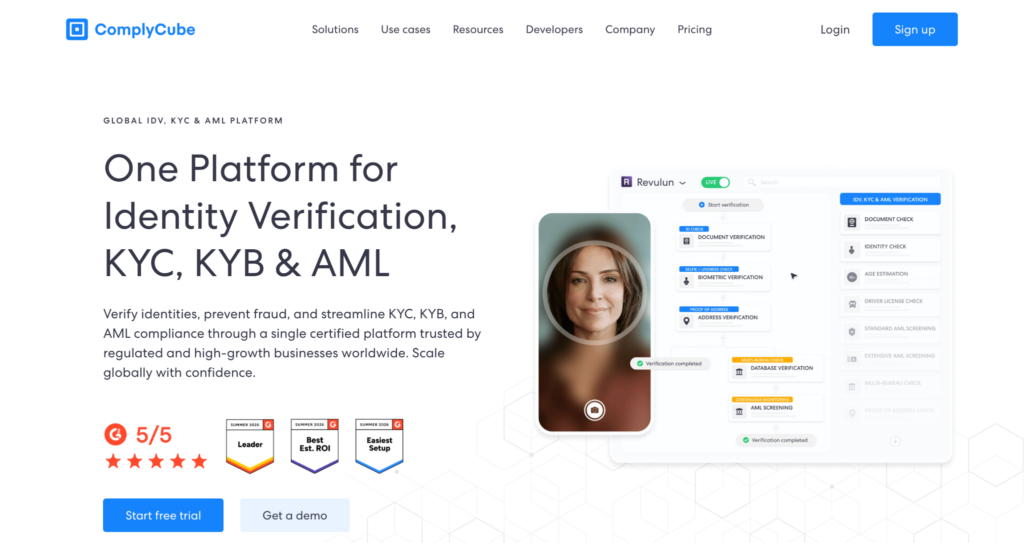
ComplyCube is an all-in-one identity verification platform where KYC, KYB, and AML screening are rolled into a single workflow. The system processes more than 10 million transactions weekly across 220-plus countries and territories. With an approximately 98 percent onboarding success rate, it provides access to over 3,000 data sources and risk signals.
- KYC, KYB, and AML screening in one workflow
- Age verification included alongside identity checks
- Built for cross-border compliance across multiple jurisdictions
Pricing
ComplyCube doesn’t publish set pricing.
| Pros | Cons |
|---|---|
| Simple and effective KYC platform with enough breadth and depth to meet most use cases | Users who seek a tailored experience often complain about their lackluster customization options |
| Seamless integration which helps deliver a compliant onboarding journey | The complexity of advanced features can be challenging for non-experts initially |
| Support gets consistent praise in most user reviews |
Best for: Businesses that want KYC, KYB, and AML screening under one roof without a hefty enterprise price tag.
7. Ondato
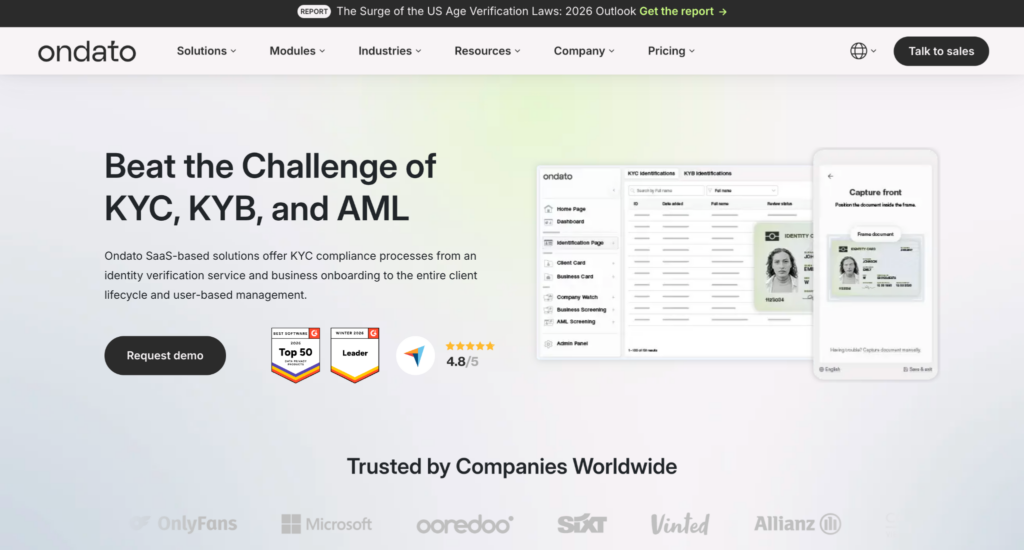
Ondato is a pioneering KYC compliance platform that packages business onboarding alongside individual identity verification. The system cuts KYC-related business costs by up to 90 percent, averages a 30-second onboarding time, and covers 192 countries against more than 15,000 global AML sources, positioning itself on speed and cost.
- Combined individual and business onboarding inside one configurable platform
- Rule-based workflows a compliance team can adjust from onboarding through lifecycle monitoring
- 192 country coverage against 15,000+ AML sources
Pricing
Ondato doesn’t publish its pricing publicly.
| Pros | Cons |
|---|---|
| Hyperfocused on accuracy and speed | Some regional document types may take time to be fully integrated |
| High level of precision minimizes fraud | Takes more than usual time for initial implementation across legacy systems |
| Process tens of thousands of verifications with 99.8% accuracy |
Best for: Mid-market teams that want combined KYC and KYB onboarding with fast setup without registry depth.
How do you pick the right KYB provider for your business?
If registry depth and ownership tracing are the actual problem, weight Know Your Customer, Moody’s, and Kyckr higher. All three treat registry data as the core product.
If you need KYB alongside individual identity checks in one integration, Trulioo, ComplyCube, and Ondato cover both without forcing a second vendor relationship. If your team already runs a case management and screening workflow and just needs a clean data feed underneath it, Kyckr’s usage-based model is built for exactly that.
What are common KYB provider red flags?
A few patterns show up across weaker KYB providers which are not so obvious in a sales demo.
1. Stale registry data
Some vendors cache registry snapshots and refresh them on a schedule, which means a business that changed ownership last month can still show its old structure. Ask exactly how fresh the data is at the moment of a query.
2. Lean ownership tracing
A provider that lists direct shareholders but doesn’t follow a holding company chain to the actual UBOs at the end only does half its job.
3. Per-lookup pricing
Lack of visibility into what a lookup actually costs at the volume of your consumption. It’s the same structural problem Sumsub users flag about its verification-based billing.
While you’re at it, check whether monitoring is actually continuous. A business that passes KYB today and turns into a shell company for laundering money next year is exactly the scenario continuous monitoring exists to catch.
Frequently asked questions
What is the difference between KYC and KYB?
KYC verifies an individual person’s identity. KYB verifies a business, its registration status, and the UBOs who own and control it. A platform can be strong at one and weak at the other, so it is crucial to take the time to decipher which feature is most important for your needs and make a decision accordingly.
What is the difference between a KYB data provider and a KYB software provider?
A data provider sells access to registry information itself without running a full onboarding workflow around it. A software provider builds screening, case management, and decisioning on top of registry data, either its own or a data provider’s. Some vendors on this list, including Know Your Customer, Moody’s, and Trulioo, do both.
How much do KYB providers typically cost?
Pricing varies by model. Some bill per verification or per lookup, which gets expensive fast at high volume. Others price by usage with no minimums or by a flat enterprise quote scaled to jurisdiction coverage and query volume. Look into the exact billing model before you commit.
Do I need a KYB provider if I already use a KYC tool?
If your customers are individuals only, a strong KYC tool may be enough. The moment your onboarding includes companies, LLCs, corporations, partnerships, you need business verification specifically, since KYC tools that bolt on business checks later often stop at the first layer of ownership.
